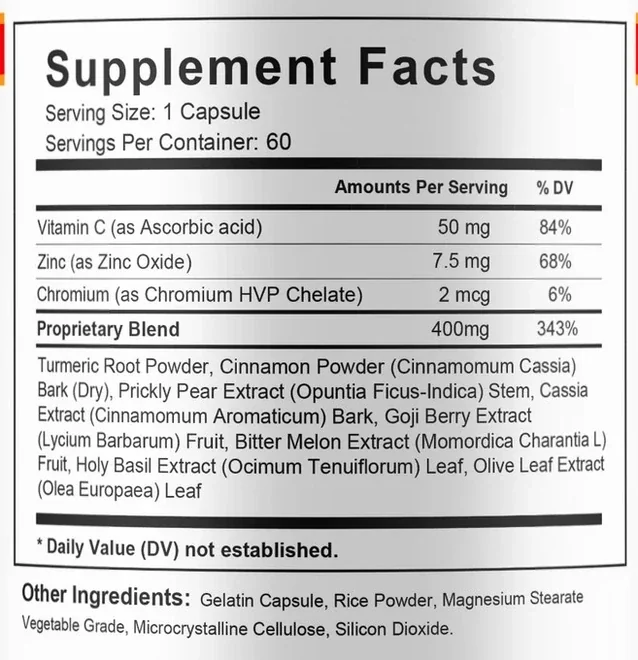
The Vital Restore supplement facts panel lists a serving size of 1 capsule, 60 servings, vitamin C, zinc, chromium and a 400 mg proprietary blend of eight botanicals1. This page reads every line of that panel and flags the five points that do not add up.
We work from photos of the Vital Restore Glycogen Support bottle supplied by the site owner. If your bottle prints anything different, trust your bottle and tell us. The label wins over any marketing panel, ad or sales page.
None of the points below proves anything is wrong with the product. They are reasons to read carefully and to ask the seller which numbers are intended.
LabelFive label notes, in red pen
- Note 1
Serving size vs directions
The panel lists a serving as 1 capsule with 60 servings. The side panel says take 2 capsules daily. At 2 a day a bottle lasts 30 days; at 1 a day, 60.
- Note 2
Per-capsule amounts
Every amount in the table is per capsule. At the directions' 2 a day, the daily totals double: 100 mg vitamin C, 15 mg zinc, 4 mcg chromium and 800 mg of the blend (our arithmetic).
- Note 3
Vitamin C percentage
50 mg is printed as 84% DV. The FDA adult Daily Value is 90 mg, so 50 mg works out to about 56% (our arithmetic).
- Note 4
Blend percentage
The blend line prints 343% in the %DV column, yet a blend has no Daily Value and the footnote says “DV not established”.
- Note 5
Logos without papers
The back label prints three roundel logos. This site has not seen any certificate behind them.
Label photos supplied by the seller.
Label transparency at a glance
3 of 11 named actives have an amount printed. The other 8 sit inside the 400 mg blend with no amount shown.
- Vitamin C50 mg
- Zinc7.5 mg
- Chromium2 mcg
- Turmericamount not shown
- Cinnamon (cassia)amount not shown
- Prickly pearamount not shown
- Cassia extractamount not shown
- Goji berryamount not shown
- Bitter melonamount not shown
- Holy basilamount not shown
- Olive leafamount not shown
Amount printed (3)Amount not printed (8)
Daily amount vs reference amount
Bar chart of the three nutrients as a share of the FDA Daily Value (chromium: NIH adequate intake for men 19–50).
2 capsules a day (directions)1 capsule a day (serving size)
Table view
Daily totals check
The label amounts are per capsule. Switch between 1 and 2 capsules to see the daily totals next to the reference amounts.
Reference amounts: FDA Daily Values (vitamin C 90 mg, zinc 11 mg) and the NIH adequate intake for chromium (35 mcg, men 19–50). Upper limits: vitamin C 2,000 mg, zinc 40 mg from all sources.
Label explorer
Tap an ingredient to see what the label says about it and the caution sources raise.
No. 01The panel as printed
Here is the Supplement Facts panel as printed, with the amount and the %DV column exactly as they appear1.
| Label line | Amount per serving | %DV printed |
|---|---|---|
| Serving size | 1 capsule | |
| Servings per container | 60 | |
| Vitamin C (as ascorbic acid) | 50 mg | 84% |
| Zinc (as zinc oxide) | 7.5 mg | 68% |
| Chromium (as chromium HVP chelate) | 2 mcg | 6% |
| Proprietary Blend | 400 mg | 343% |
Under the table, the footnote reads: Daily Value (DV) not established1. The blend then lists eight botanicals in this order: turmeric root powder, cinnamon (Cinnamomum cassia) bark powder, prickly pear (Opuntia ficus-indica) stem extract, cassia (Cinnamomum aromaticum) bark extract, goji berry (Lycium barbarum) fruit extract, bitter melon (Momordica charantia) fruit extract, holy basil (Ocimum tenuiflorum) leaf extract and olive leaf (Olea europaea) leaf extract.
For what each ingredient is and what sources say about it, see the ingredients page.
No. 02Point 1: one capsule per serving, two capsules per day
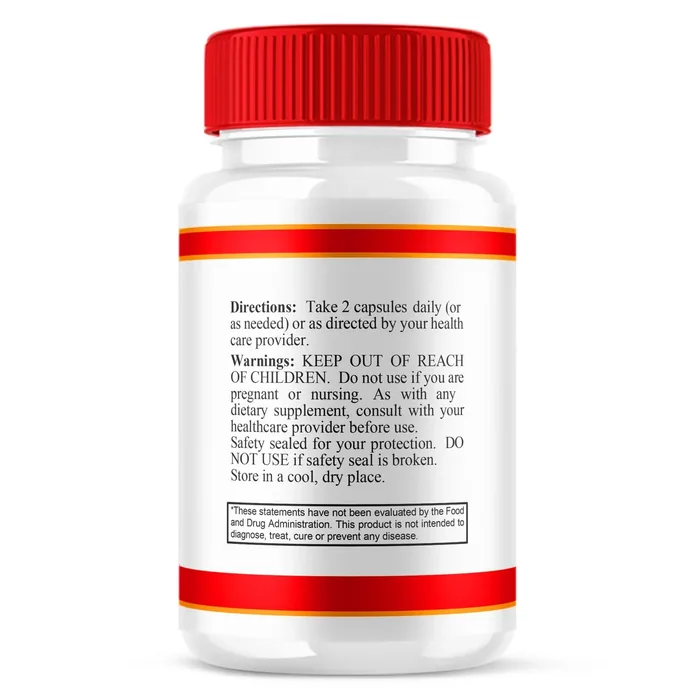
The panel says a serving is 1 capsule, but the side-panel directions say to take 2 capsules daily, or as needed, or as directed by your health care provider1.
Labels usually set the serving size to match the amount you are told to take. Here they differ. That changes how long a bottle lasts:
- At 2 capsules a day, as the directions say, 60 capsules last 30 days.
- At 1 capsule a day, matching the serving size, they last 60 days.
The phrase or as needed is not explained. The label does not say whether it allows fewer capsules or more, and it never names a maximum beyond the directions themselves. Follow the printed directions, do not take more than they say, and ask your doctor or pharmacist which amount suits you. It is also fair to ask the seller which amount they intend. The how to use page covers this in practical terms.
No. 03Point 2: what two capsules add up to
Because every amount on the panel is per single capsule, taking 2 capsules a day doubles each figure.
By our own arithmetic from the label, 2 capsules a day would provide:
- 100 mg vitamin C
- 15 mg zinc
- 4 mcg chromium
- 800 mg of the proprietary blend
These are not printed on the bottle. They matter most for zinc, because the upper limit for adults is 40 mg a day from all sources, food and other supplements included2. If you already take a multivitamin or a zinc product, add those amounts in before deciding anything. Your pharmacist can do this check with you in a minute.
No. 04Point 3: the vitamin C percentage looks high
The panel prints 84% DV for 50 mg of vitamin C, but against FDA's adult Daily Value of 90 mg, 50 mg works out to about 56%3.
That 56% is our arithmetic, not a number on the label. The printed 84% would fit a lower reference value than the one FDA uses for adults today. Either way the amount itself, 50 mg, is clear. For context, most US adults get enough vitamin C from food, and the upper limit is 2,000 mg a day3.
If the percentage matters to you, ask the seller which reference value the label used. See the vitamin C and zinc page for daily amounts by age and sex.
No. 05Point 4: a %DV printed for the blend
The blend line prints 343% in the %DV column, although a blend of herbs has no Daily Value and the label's own footnote says DV not established1.
A Daily Value exists only for nutrients that FDA has set one for, such as vitamin C and zinc. Herbs like turmeric or bitter melon have none, so a percentage on that line has nothing to be measured against. FDA's labeling guide for supplement makers covers how proprietary blends are meant to appear on the panel4.
The most likely reading is a printing or layout error, but this site cannot confirm that. Do not read 343% as meaning the capsule holds more than three times anything. The proprietary blend page explains what a blend line can and cannot tell you.
No. 06Point 5: zinc and chromium are consistent
The zinc and chromium percentages do add up, which helps show the other two points are worth asking about rather than typical.
Zinc at 7.5 mg printed as 68% matches the Daily Value of 11 mg2. Chromium at 2 mcg printed as 6% is close to 2 out of 35 mcg, the adequate intake for men aged 19 to 505. Two mcg is a small amount of chromium compared with that figure, and the adequate intake is lower for women and for adults over 50, at 20 to 30 mcg depending on group5. Because these two lines check out, the vitamin C and blend lines stand out more clearly. A label can be mostly right and still carry one or two errors, which is why reading every line is worth the few minutes it takes. More is on the chromium page.
No. 07Front panel words and back-label logos
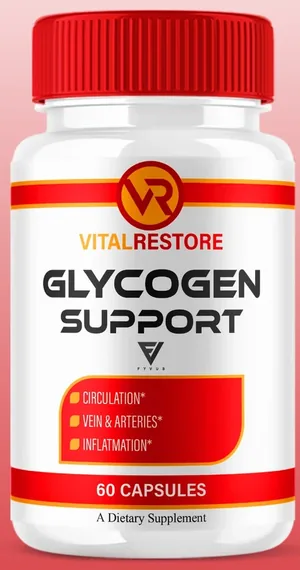
The front panel prints three short marketing words about circulation, veins and arteries, and inflammation, each with an asterisk; this site does not repeat them as claims1.
One of those words is printed with a spelling error on the bottle. On supplement labels, asterisks like these usually point to the standard FDA statement on the side panel, which the template on this site also shows.
The back label prints three logos: an ISO roundel, a manufacturing-practice roundel and a US flag1. This site has not seen certificates behind them, so we do not describe them as facts about how or where the product is made. The label does not state where the capsules were made.
No. 08Questions to put to the seller
Send the seller a short written list of questions, and keep their answers with your order email.
Each of the five points above turns into one clear question. Written answers are easier to check later than a phone call, and they give your doctor or pharmacist something concrete to read.
- Is the intended daily amount 1 capsule or 2 capsules, and what does or as needed mean?
- What reference value was used for the 84% printed beside vitamin C?
- What does the 343% on the blend line refer to?
- How many milligrams of each of the eight botanicals are in one capsule?
- Is a certificate of analysis available for the lot printed on my bottle?
The seller's pack lists an order desk at +1 (302) 200-3480 for orders, and the label lists the distributor's own line for product questions6. If the answers you get differ from what this page says, please tell us so we can update it.
While you wait for answers, the label still gives clear guidance: follow the printed directions, do not take more, and talk to your doctor or pharmacist first, especially if you take any medicine.
No. 09Distributor, warnings and batch codes
The back label names Amplify Distribution, LLC, 7904 E Chaparral Rd STE A110618, Scottsdale, AZ 85250, with a questions line at +1 (623) 377-46091.
The side panel adds these warnings1:
- Keep out of reach of children.
- Do not use if you are pregnant or nursing.
- Consult your health care provider before use.
- Do not use if the safety seal is broken.
- Store in a cool, dry place.
The seller's pack lists lot VR-26/VT-893 and a certificate-of-analysis reference VR-893-26-VT; check your own bottle6. This site has not seen that certificate. The pack says the lot and best-before date are on the base when the bottle shows them. The bottle check page shows how to compare your bottle with the label described here.
Orders and refunds go through a separate order desk, not the distributor line. Prices are shown at checkout.
Safety: Vital Restore is for adults. The label says do not use it if you are pregnant or nursing, and to talk with your healthcare provider before use. If you take diabetes medicine, a blood thinner, blood-pressure or thyroid medicine, or have liver or kidney disease, ask your doctor or pharmacist first. Never use a supplement in place of medicine you have been prescribed. Stop and seek medical help if you have a reaction.
Frequently asked questions
What is the serving size on the Vital Restore label?
One capsule, with 60 servings per container. The directions, however, say to take 2 capsules daily, so ask your doctor or pharmacist which amount applies to you.
Why does the vitamin C line say 84% when 50 mg is about 56%?
We do not know. FDA's adult Daily Value for vitamin C is 90 mg, and 50 mg of 90 mg is about 56% by our arithmetic. Ask the seller which reference they used.
What does 343% on the blend line mean?
It has no clear meaning. Herbal blends have no Daily Value, and the label's footnote says DV not established. Read it as a label point to ask about, not a dose.
Are the label amounts per capsule or per day?
Per capsule. At the printed directions of 2 capsules a day, the daily totals would be double, for example 15 mg zinc. That doubling is our arithmetic.
Who distributes Vital Restore according to the label?
The back label names Amplify Distribution, LLC in Scottsdale, Arizona, with a phone line for questions. Orders are handled by a separate order desk.
Does the label say where Vital Restore is made?
No. It prints a US flag logo among three back-label logos, but it does not state a place of manufacture, and this site has not seen certificates behind the logos.