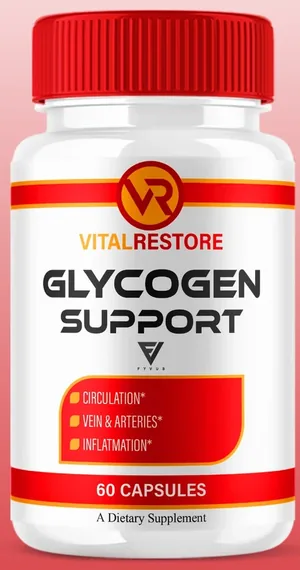
The Vital Restore vitamin C percent daily value on the bottle is printed as 84%, but 50 mg works out to about 56% of the FDA Daily Value. The two numbers do not match.
This post shows the arithmetic for Vital Restore Glycogen Support, step by step, and then checks zinc and chromium the same way. The sums are this site's own arithmetic. This site has not tested the product, so the mismatch is a reason to read the label with care, not proof of a problem.
No. 01What does the label print for vitamin C?
The Supplement Facts panel prints vitamin C (as ascorbic acid) at 50 mg per serving, with 84% in the %DV column1.
The serving size is 1 capsule, and the panel lists 60 servings per container1. The side-panel directions say to take 2 capsules daily, so the per-capsule figures double at the directions' amount. Our arithmetic: 2 capsules gives 100 mg of vitamin C a day.
The panel also carries a footnote that a Daily Value is not established for some lines. Keep that in mind when you read the blend row, which prints its own percentage.
No. 02How do you work out the real percentage?
Divide the amount by the Daily Value and multiply by 100. The FDA Daily Value for vitamin C is 90 mg for adults2.
Our arithmetic: 50 divided by 90 is 0.556, so about 56%. At 2 capsules a day, 100 divided by 90 is about 111%.
The printed 84% does not match either sum. If you rearrange it, 84% of 90 mg would be about 76 mg, which is not the amount on the panel. This site cannot say why the figure differs, and it does not guess.
No. 03Do zinc and chromium match their printed values?
Zinc matches and chromium is close. The label prints 7.5 mg zinc at 68% DV, and the Daily Value for zinc is 11 mg3.
| Item | Label amount and %DV | Our check against the DV |
|---|---|---|
| Vitamin C | 50 mg, 84% | 50 / 90 = about 56% |
| Zinc | 7.5 mg, 68% | 7.5 / 11 = about 68% |
| Chromium | 2 mcg, 6% | 2 / 35 = about 6% |
| Proprietary blend | 400 mg, 343% | No Daily Value exists |
For chromium, the 35 mcg figure is the adequate intake for adult men, as the NIH fact sheet gives it4. That is a reference intake, and this site is only showing that the printed 6% sits near 2 divided by 35.
No. 04Why does the blend row print 343%?
A proprietary blend has no Daily Value, so a percentage on that row has nothing to be measured against. The label itself says a Daily Value is not established for those lines1.
The row prints 343% beside the 400 mg blend1. FDA guidance on proprietary blends covers how blends are listed on a supplement label5. This site does not read that guidance as saying anything about this specific bottle.
The blend holds eight botanicals, and the label gives no separate amount for any of them. See the proprietary blend page for the full list.
No. 05What are the upper limits for vitamin C and zinc?
The NIH upper limit for vitamin C is 2,000 mg a day, and for zinc it is 40 mg a day from all sources23.
Our arithmetic: at 2 capsules a day, the label amounts add up to 100 mg vitamin C and 15 mg zinc. Both are below those limits on their own. The limits count food, drinks and other supplements together, so your total depends on what else you take.
- Vitamin C upper limit: 2,000 mg a day.
- Zinc upper limit: 40 mg a day from all sources.
- Too much zinc over time can lead to copper deficiency and nerve problems3.
Check the vitamin C and zinc page for more on both nutrients.
No. 06What does the mismatch mean for you?
It means the printed percentage is a poor guide, so use the milligram amounts instead and ask the seller about the difference.
The source facts do not say what Vital Restore will do for you, and nothing on this page does either. Most US adults get enough vitamin C from food, according to the NIH fact sheet2. That says nothing about this capsule.
Compare the printed numbers on your own bottle. If they differ from the ones here, the bottle in your hand is the one to trust. The legit page lists other label checks, and the Supplement Facts page has the full panel.
If you take other supplements or have a kidney condition, ask your doctor or pharmacist about your total intake first.
Safety: Vital Restore is for adults. The label says do not use it if you are pregnant or nursing, and to talk with your healthcare provider before use. If you take diabetes medicine, a blood thinner, blood-pressure or thyroid medicine, or have liver or kidney disease, ask your doctor or pharmacist first. Never use a supplement in place of medicine you have been prescribed. Stop and seek medical help if you have a reaction.
Frequently asked questions
Is 84% the right percentage for 50 mg of vitamin C?
Not against the FDA Daily Value of 90 mg. Our arithmetic gives about 56%. The label does not explain the 84% figure, so ask the seller.
Does the vitamin C mismatch mean the capsule is unsafe?
No. It is a labeling point that does not add up. It is a reason to read carefully and ask questions, not proof that anything is wrong with the product.
How much vitamin C do 2 capsules add up to?
Our arithmetic gives 100 mg a day at the directions' 2 capsules. That is well below the 2,000 mg upper limit, which counts all sources together.
Why does the zinc percentage match when vitamin C does not?
Zinc at 7.5 mg divided by the 11 mg Daily Value gives about 68%, which is what the label prints. Vitamin C is the line that departs from its Daily Value.
Should I use the percentages or the milligrams?
Use the milligrams. They are the amounts per capsule, and you can compare them with the reference values yourself or with a pharmacist.